
I've been there. You look in the mirror, decide it's time for a change, and immediately ask, "Okay, but what exactly do I need to eat?"
The internet is full of generic advice like "just eat less" or "cut carbs." But "less" is vague, and cutting carbs doesn't work if you're still eating 4,000 calories of cheese.
That's why I laid out this calculator. It doesn't judge, and it doesn't guess. It uses the Mifflin-St Jeor equation—widely considered by dietitians and health organizations to be the most accurate method for estimating calorie needs—to give you a starting line.
How This Wizardry Works
It breaks down into two main concepts that sound complicated but are actually pretty simple:
- 1
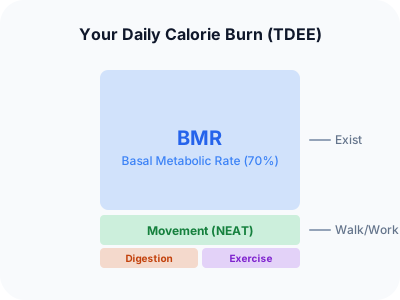
BMR (Basal Metabolic Rate)
This is the energy your body burns just to exist. If you stayed in bed all day binge-watching Netflix and didn't move a muscle, this is what you'd burn. It keeps your heart beating and your brain thinking.
- 2
TDEE (Total Daily Energy Expenditure)
Real life happens outside of bed (mostly). TDEE takes your BMR and multiplies it by your activity level. Do you walk the dog? Hit the gym? Work construction? All that movement burns extra fuel.
My 3 Golden Rules for Using These Numbers
1. Consistency > Intensity
It's better to hit a modest deficit (like 250-500 calories under maintenance) every single day than to starve yourself for three days and then binge on the weekend. The "Mild Weight Loss" number in the calculator is often the most sustainable path to long-term success.
2. Not All Calories Are Created Equal
Technically, 500 calories of gummy bears and 500 calories of grilled salmon are the same energy. But the salmon will keep you full for hours and build muscle, while the sugar will leave you crashing and hungry in 30 minutes. Use these numbers as a budget, but spend it wisely on protein and fiber.
3. Re-calculate as You Shrink
This is crucial! As you lose weight, your body requires less energy to move around. A 200lb person burns more than a 180lb person. For every 10-15 lbs you lose, come back here and re-calculate to ensure you don't hit a plateau.
What About Macros? (Protein, Carbs, Fats)
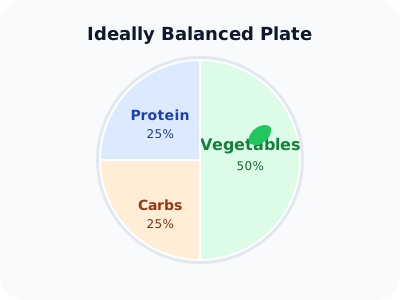
So you have your calorie target. Great! Now, how do you fill it? While calories determine weight change, macronutrients determine body composition change (i.e., whether you lose fat or muscle).
Protein (40%)
Essential for muscle retention during weight loss. Aim for high protein to stay full.
Carbs (30-40%)
Your body's primary fuel source. Don't fear them, just choose complex sources like oats and veggies.
Fats (20-30%)
Crucial for hormone regulation. Don't go too low or you'll feel terrible.
Frequently Asked Questions
Is this calculator accurate for everyone?
It is accurate for the vast majority of the population. However, outliers exist. Extremely muscular athletes might find it underestimates their needs (muscle burns more than fat), while those with certain metabolic conditions (like hypothyroidism) might find it overestimates. Think of this as a very precise starting estimate, not a divine law.
Which Activity Level should I choose?
This is where 90% of mistakes happen. If you have an office job and go to the gym for 45 minutes, you are likely "Lightly Active" or at most "Moderately Active," not "Very Active." The exercise calories are nice, but sitting for 8-10 hours cancels a lot of that out. When in doubt, pick the lower option to be safe.
Should I eat back my exercise calories?
Great question. If you selected an activity level that accounts for your exercise (like "Moderate" for 3-5 days of gym), then NO. The calculator already added those calories in. If you eat them back, you're double-counting and won't lose weight.
What is the "Zig-Zag" method?
Some people stall if they eat the exact same amount every day. The Zig-Zag method involves eating more on some days (high days) and less on others (low days) while keeping the weekly average the same. This can help prevent metabolic adaptation and keep you sane by allowing for bigger meals on weekends.
How fast should I lose weight?
Expert consensus suggests 1-2 lbs (0.5-1 kg) per week is safe and sustainable. Losing weight faster than that often results in muscle loss and a higher chance of gaining it all back (the dreaded yo-yo effect). Patience is the fastest route to a permanent result.
Why does age lower my calorie needs?
Sadly, as we age, our metabolism naturally slows down, mostly because we tend to lose muscle mass. This calculator adjusts for that. It’s a good reminder that strength training becomes even more important as we get older to keep that metabolic fire burning!